
 There are four main types of MS. Each one has a different progression trajectory.
Every person with multiple sclerosis lives his or her life with a completely different illness. Different types of MS each have a unique impact on a person’s health. No two people suffer the same symptoms.
Consequently, it is often difficult for family and loved ones to understand how traumatic life is for MS sufferers. It is very distressing living with the disconcerting barrage of attacks on their bodies daily. Nerve damage is always involved, and the pattern is unique for each suffering from MS.
People’s experiences with MS can be vastly different. Over the years, Medical professionals and research scientists have identified four main types of MS. These different types of MS are essential in determining how a person with MS will respond and benefit (or not) from treatment.
Their names tell the way that the disease impacts on the body over time. The type of MS diagnosed directly affects where you can get HSCT and which facilities will accept you.
- RELAPSE REMITTING MULTIPLE SCLEROSIS (RRMS)
- SECONDARY PROGRESSIVE MULTIPLE SCLEROSIS (SPMS)
- PRIMARY PROGRESSIVE MULTIPLE SCLEROSIS (PPMS)
- PROGRESSIVE RELAPSING MULTIPLE SCLEROSIS (PRMS)
TYPES OF MS: RELAPSE REMITTING MS (RRMS)

The majority of individuals with multiple sclerosis, approximately 90% will suffer from relapsing-remitting MS. Generally speaking, and symptoms will first appear at any time between their early 20’s and their 40’s.
Subsequently, periodic attacks (relapses) have complete or partial recovery (remissions). Relapse remitting MS (RRMS) as a label helps to identify your specific type of the disease and direct you to determine the most effective treatments available for this form.
What it cannot do, however, is forewarn you on how this variety will affect your health in the short and long term.
The map of nerves affected, the severity of attacks, and the time between relapses varies widely from person to person. The definition of a relapse has confounded neurologists for decades.
But is now known as an episode of neurological symptoms. These occur at least 30 days post any previous event and last a minimum of 24 hours. Symptoms are not directly attributable to another cause. It must also occur in the absence of any fever or apparent infection. Previous symptoms might then appear in a different area of the body. Relapses symptoms may be mild to severe.
Hospital treatment may be vital for the most severe. An MS nurse or doctor can care for many at home with the support of medical professionals. A “flare-up” or exacerbation would be evidence of a relapse. Disease-modifying drugs (DMDs) treat this form of MS.
SECONDARY PROGRESSIVE MULTIPLE SCLEROSIS
 In most cases, after living with relapsing-remitting MS for multiple years, a large proportion of people will develop secondary progressive MS (SPMS).
This type of MS has symptoms that begin with a steady progression, without either relapses or remissions. (In this regard secondary progressive MS is comparable to primary progressive MS). The transition typically occurs between 10 and 20 years post-diagnosis of relapsing-remitting MS.
Although relapsing-remitting MS is generally unpredictable, the pattern of apparent attacks followed by recovery tends to be consistent. SPMS relapses are less distinct. When relapses do occur, recovery is not as complete. Disabilities remain and appear worse in many respects.
Symptoms that may indicate you are progressing to SPMS include:
- Tight and stiff feeling in the leg muscles
- Increase in weakness and un-coordination
- More pronounced fatigue and depression accompanied by more difficulty with cognitive issues than previously experienced.
- Bladder and bowel problems
It is crucial to compare symptoms over some time to confirm that a patient has SPMS. Therefore you must inform your neurologist of changes that you notice. The older a person is when initially diagnosed, the shorter the time for the disease to develop into a secondary progressive form.
Drugs are generally no help to SPMS patients without relapses, and can sometimes have a detrimental effect on progression.
It is essential to compare symptoms over some time to confirm that a patient has SPMS.
TYPES OF MS: PRIMARY PROGRESSIVE MS (PPMS)

Primary progressive MS gets its name because it impacts the person from the get-go (primary – first). In primary progressive MS, early symptoms appear to be subtle problems with walking, which develop – often slowly – over time.
Symptoms gradually get worse over time rather than appearing as sudden unexpected attacks. Approximately 10-15% of MS patients suffer from this form of the disease.
Symptoms, however, varied, and whatever forms they take, they generally mean deterioration over time. Even though over the long-term symptoms may gradually become worse, for extended periods, they could remain much the same with no noticeable changes.
People who get MS in their forties or fifties, generally get PPMS. However, diagnosis can occur either earlier or later.
People who get MS in their forties or fifties, generally get PPMS.
In contrast to relapse remitting MS, Primary-Progressive MS usually has equal numbers of men and women are with this form. In other types of MS, women outnumber men three to one.
People with primary progressive MS can experience many of the same symptoms as those with relapsing-remitting MS. Unfortunately, Primary progressive MS tends to lead to disability earlier than relapsing-remitting MS.
Perhaps the most upsetting difference in primary progressive MS is its inadequate response to treatment. So far, no medications have helped, other than HSCT, which stops the underlying disease progression and has shown improvement in disability for many of the PPMS patients treated under Dr. Federenko at the AA Maximov Institute in Russia (please see HSCT Facilities).
PROGRESSIVE RELAPSING MS (PRMS)
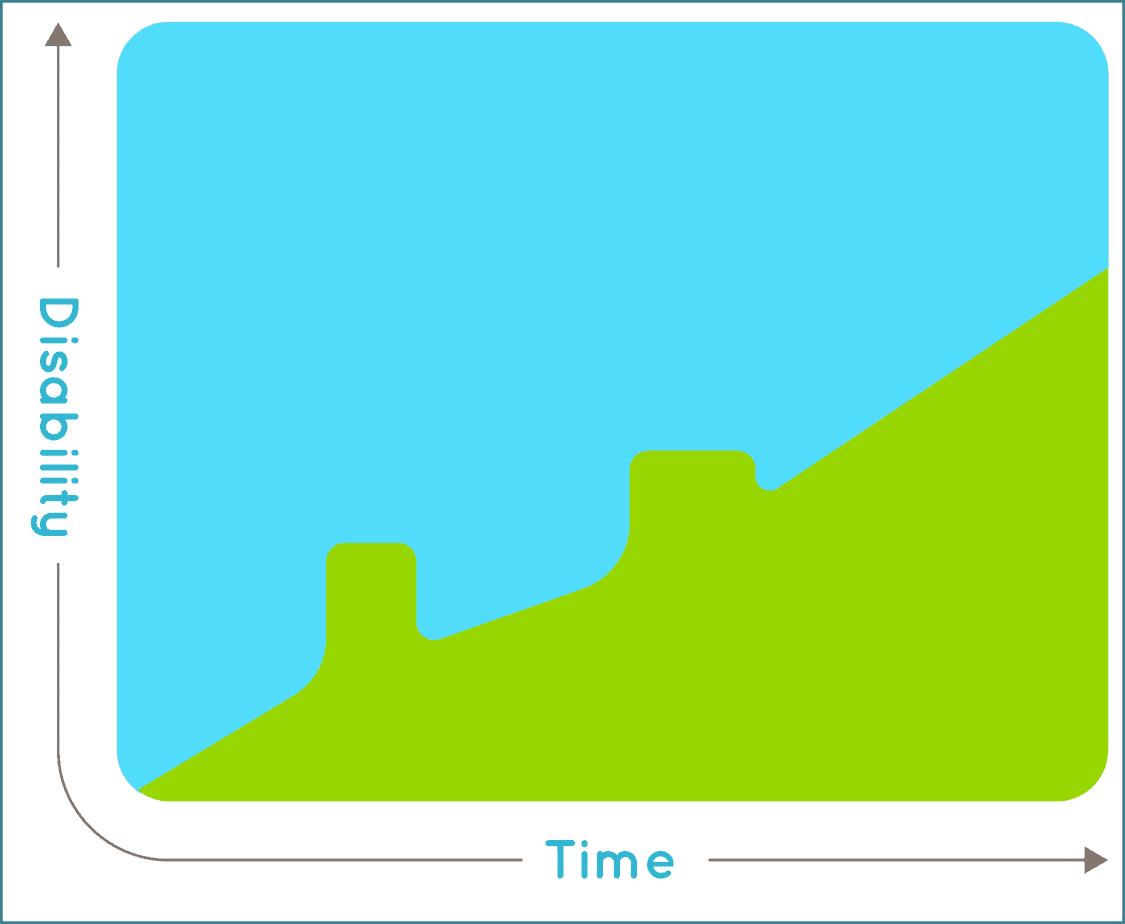
Progressive-relapsing MS (PRMS) represents the minority of people affected by this disease. Patients with PRMS account for approximately five percent of Multiple Sclerosis cases. This form of MS has a steady progression in disability, and uncertain bouts of recovery.
People with progressive relapsing MS initially appear to have primary progressive MS. PRMS has a consistent progression of decreased neurological function, accompanied by relapses.
Neurologists or health professionals can’t predict the rate at which PRMS progresses. The progression is often a slow but steady process that spans many years—aggressive cases of PRMS show, particularly rapid progression.
A progressive and rapid decline in neurological function, is what Primary Progressive MS patients experience. Temporary worsening of symptoms or increased disability is evidence of a flare-up. It is essential to understand the types of MS that benefit from HSCT. There are currently several trials in progress.
COIMBRA HIGH DOSE VITAMIN D PROTOCOL
If you are thinking about HSCT for MS, you should take a look at the Coimbra protocol, which has a success rate of 95% for stopping the progression of MS and other autoimmune diseases.
I have ms for 20 years. Its spms now. I did the hsct treatment in the Phillepines and mayebay the ilness stopped but my walking is still terrible. I can walk only 50 metres. The clock is still ticking,i am already 55.
Is there any suggestion what i could try now
Hi George thanks for reaching out. Congratulations on completing HSCT treatment successfully. At least you have managed to halt the progression of the disease it would seem. Unfortunately there is little that can be done for long term axonal pathway damage that has already occurred before you are treated with HSCT. What is really needed now is re-myelation. Regenerating the myelin is what is needed. I am currently researching various doctors that have had varying degrees of success using stem cells. Not HSCT treatment but targeting area’s that are in need of myelin regeneration. Here is an interesting article.
https://www.ncbi.nlm.nih.gov/pmc/articles/PMC3250284/” rel=”noopener” target=”_blank”>
There are doctors throughout the world that have had great success treating athletes in targeted areas of injury. I will be updating the site with this information once I have compiled all of the information. However I highly recommend looking at the Coimbra Vitamin D Protocol in the meantime and also the use of Biotin. 100mg 3 times per day as in the French study. If you can keep yourself as well as possible for now I honestly do believe that new treatments will be available soon that can help progressive patients like us actually heal some of the damage that has occurred over a longer period of time. I will message you when I post the Myelin regeneration information.
Thanks. I will read the article and follow your advice. I hope it helps a little. I need it!
Would a treatment like this work on a patient who has Tumefactive MS?
Hi Nicole,
I would advise that you contact a facility directly to be assessed for treatment and to seek advice on how effective it would be for your specific symptoms. However I would imagine that is would be as effective for Tumefactive MS as relapse remitting MS. If the Tumefactive MS is indeed relapse remitting or recently diagnosed. I am not a doctor and evaluation from doctors at the various facilities is paramount in seeking HSCT treatment. Good luck.
Hi, I’m really interested having found your site. I don’t seem to have MS, but in 1976 I got what they called viral demyelinating polyneuritis. I thought it similar to mild GBS when I later heard of a famous person getting it. This developed into what I generically call chronic fatigue. I also benefited from thyroid along the way, and I now need it. I’ve developed other hormonal issues too overproduction, and now have kidney damage because that caused high blood pressure. They’ve diagnosed me with fibromyalgia. I’d love to do ketosis again but I think I can’t because of the amount of protein you eat, and my need to limit phosphorus intake. I’d love to do high Vit D (I’m deficient due to the kidney disease) but my parathyroid issues make me nervous, and I’ve already lost bone density. I’m also super sensitive to chemicals and many foods, and getting more so.
I suspect I have autoimmune issues, and I still feel the numb patches, twitches and weakness I got at the outset. I’ve really lost condition and strength in recent years. Does any of this strike a note with you please? I’m in the U.K. thank you
Hi Belinda, sorry to hear about your health issues. It seems you have very similar symptoms to MS. You do no need to eat huge amounts of protein on keto, in fact, there are many vegan keto followers. Google it. It may be worth your while to look at the Anne Borach diet. It is clear that whatever is going on with you it is autoimmune led. Many people have had success with AB. One lady I know spent 18 years in a wheelchair and has been on her feet now for 2 years since adhering to the AB. You can probably up your vitamin D to 5,000IU per day with no adverse side effects as this is not a huge dose. I suggest the AB because of all of your food allergies. I also find that regular water fasting has been very effective for helping with everything. There are groups on Facebook to join if you are interested in this. Good luck.