

People considering treatment will find it confusing that there are two different types of HSCT available. Myeloablative versus Non-Myeloablative HSCT is the inevitable question facing most HSCT candidates.
Understanding what differentiates Myeloablative from Non-Myeloablative HSCT is essential when researching your treatment. It will help you to decide which type of HSCT is appropriate for your specific needs, as well as where to go for treatment.
On the whole, most facilities offering HSCT will opt for one type or the other. There are currently no facilities that offer both kinds of HSCT.
MYELOABLATIVE VERSUS NON-MYELOABLATIVE HSCT – WHAT IS THE DIFFERENCE IN THE TWO TYPES OF HSCT?

MYLEOABLATIVE and NON-MYELOABLATIVE HSCT are both equally respected forms of treatment. Both types ablate (destroy) the lymphocytes in the body that have become self-intolerant.
The lymphocytes are responsible for the underlying nerve damage/ destruction to the myelin. These are the white blood cells that, in normal circumstances, destroy bacteria and other harmful substances in the blood.
In terms of MS, these usually helpful cells become ‘rogue.’ They become intent on attacking the Myelin sheath that surrounds and protect our nerves. Both types of HSCT remove these errant blood cells. HSCT replaces these with ‘Naive’ cells that have not been corrupted and behave correctly!
MYELOABLATIVE VERSUS NON-MYELOABLATIVE HSCT: MYLEOABLATIVE HSCT

Myeloablative HSCT is the more stringent type of treatment. This type of HSCT destroys the body’s (autoreactive) lymphocytes as well as the bone marrow.
Myeloablative HSCT most commonly incorporates a BEAM (Carmustine, Cytarabine, Etoposide, Melphalan) chemotherapy protocol. The chemotherapy takes place over six days. ATG can be supplementary, for a couple of days, rather than as an essential lymphoablation.
Many HSCT doctors consider Myeloablative to be the most ‘reliable’ form of HSCT. The protocol destroys the lymphocytes more completely and ultimately reduces the chance of any of the ‘baddies” surviving!
Myeloablative HSCT involves using higher doses of chemotherapy, which is harder on the body.
Some facilities feel more comfortable with this form of HSCT because it has shown to have less chance of failing as well as to be more effective for progressive forms of MS. That said, none of the facilities practicing this type of HSCT accept progressive patients, due to their affiliations with the EBMT (find out more about this on this page).
Some facilities have developed their protocol that is somewhere between Myleoblative and Non-Myeloablative HSCT. The facility at the MAKATI MEDICAL CENTER in the Philippines would be an example of this.
NON-MYLEOABLATIVE HSCT
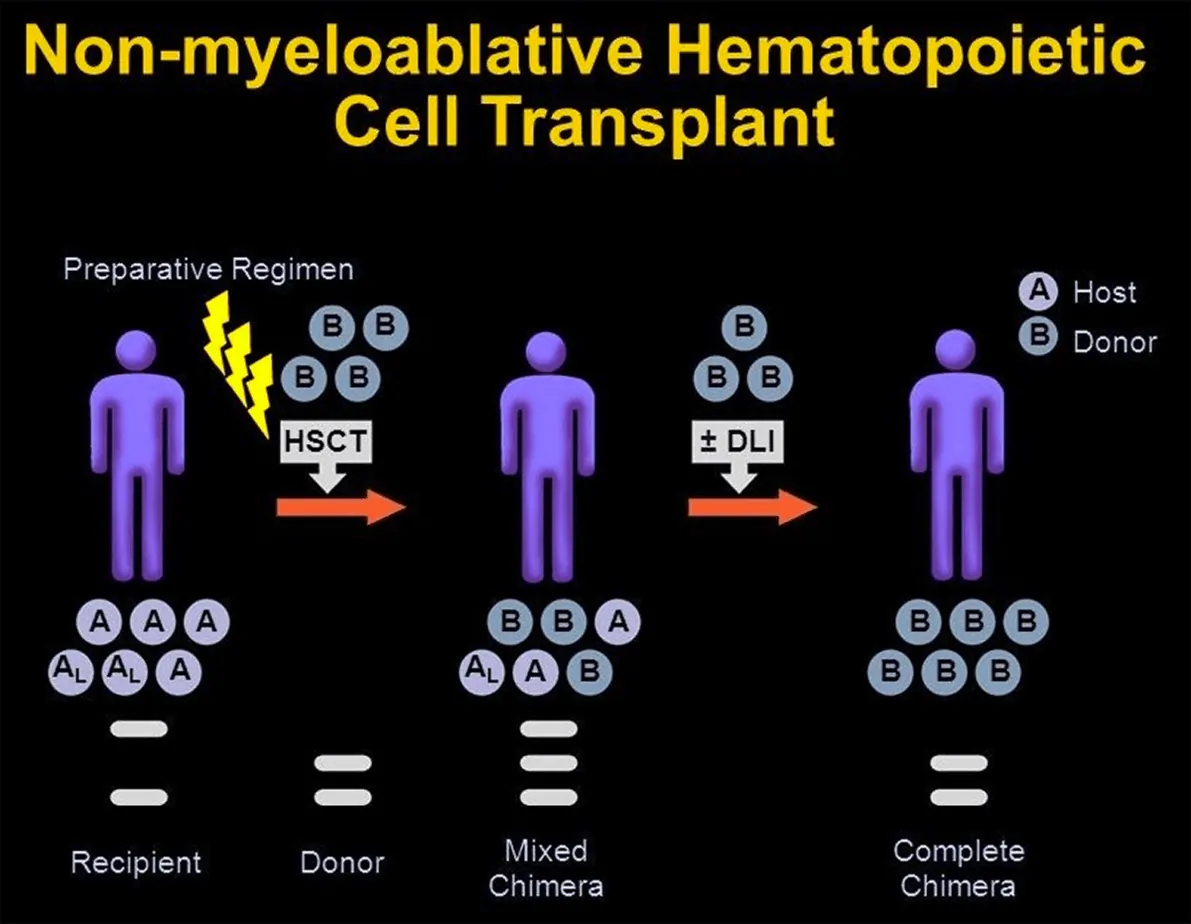
The Non-Myeloablative protocol varies according to the doctor performing it. On the other hand, the procedure is much less harsh on the body than Myeloablative HSCT.
Lymphocytes are “diminished” to a threshold level below which autoimmune-mediated damage occurs. With this form of HSCT, the bone marrow remains intact, making the treatment less dangerous. The patient can recover more quickly.
This “gentler” chemotherapy has a lower mortality rate. However, the trade-off is that compared with the Myeloablative protocol, there remains a proportion of patients (20-25%) that fail to halt their disease progression. Essentially, the treatment does not succeed in destroying all of the lymphocytes necessary to stop MS.
If this happens, the patient receives “top-ups” of cyclophosphamide infusions (more chemo) or alternative agents post-transplantation. Re-treatments often address this issue. Using “top-ups” is very common with many facilities. It will help an MS patient that has not responded favorably to go into remission.
In Mexico, for instance, Rituximab top-ups are part of the protocol. Therefore once the patient returns to their own country, these continue. Arranging this with a hospital in their home country is necessary.
MYELOABLATIVE VERSUS NON-MYELOABLATIVE HSCT: CONCLUSION
The consensus among most Hematologist’s until recently has been that if you have a progressive form of MS (PPMS or SPMS), Myeloablative HSCT has been the most effective form of treatment.
The general trend, however, with treatment today is a movement towards non-myeloablative as a preferred treatment around the world. It is less harsh on the body, and recovery is much faster.
Ironically, there are currently no places that offer Myeloablative HSCT to treat progressive cases of MS. The facilities that use Myleoblative HSCT are all signed up to the EBMT and treat only Relapse Remitting forms of MS.
In the past few years, many new facilities performing HSCT have opened up. These are located all over the world, and each one delivers its uniquely specific form of HSCT. Each Hematologist has a unique preferred protocol.
Non-Myeloablative HSCT has emerged as the most popular form of HSCT. It is exciting to see very successful results with Non-Myeloablative HSCT for PPMS and other progressive cases. The Maximov Facility in Russia regularly treats progressive cases. The protocol is continually being refined, tweaked and improved.
In Russia specifically, Dr. Denis Fedorenko prides himself on customizing the treatment to suit each new patient. In conclusion, Non-Myeloablative HSCT is a more comfortable procedure to endure. That, coupled with faster treatment and recovery times, continue to popularize this option. It also enables people who are older or perhaps less robust to get treatment and come through it more successfully.
THE COIMBRA PROTOCOL
If you are seriously considering HSCT as a treatment for MS, you should have a look at the Coimbra high dose vitamin D Protocol, which has a 95% success rate in halting disease progression.
I have been researching HSCT for my PPMS. I’m 45 yrs, had it since 1995. Done Rebif, Copaxone, then Mitozantrone. it was good for about 10 yrs, now it has turned PPMS within the year.
I’m ready for this. Let’s DO THIS!
Hi Robyn it must be SPMS as PPMS is diagnosed at the outset. If it was originally RRMS then it would have progressed to SPMS. I hope you have applied to a facility to get treatment. They are listed on the facilities list. Good luck! 🙂
diagnosed in 1985 as RLRM MS. am now on tecidera since first made available. hoping to repair loss and stop new activity, my May 2014 mri showed I had no new lesions since prior year, Will stem cel therapy for MS repair existing loss and stop further activity? what are my next steps recommended. I have been treated by dr.dina jacobs at HUP. She tells me she has patients
who have done stem cel but HUP does not offer this therapy.
Hi Debra, It is hard to say whether HSCT would help you when you have had MS for an extended period of time. It works best for those who were diagnosed within 5 years…..10 is an upper estimation, although people who have had it for 15 years have experienced stopping progression. The longer you have had it the less likely you are to benefit from regaining lost motor skills. However if your intention is to stop progression alone. Good luck!
Hello i still have no diagnostic of ms but i have some symptoms should i wait until get clinical diagnostic?
To get hsct
Thanks Luis
Hi Luis, all facilities require a positive diagnosis of HSCT along with an MRI report to confirm, so yes you would have to have this before you can apply anywhere. Good luck.
Hello, I was initially diagnosed with RRMS 12-12-2002 and within the last 2 years diagnosed with SPMS. Does HSCT treatment have history of stopping MS since I have had thiyears, diagnosed with SPMS. Does HSCT treatment have history of working after having MS for 14 years ?
Thank you
Dianna